July 28, 2026
NFPA 96 Certified Hood Cleaning: What Your Certificate and Compliance Sticker Actually Mean
uday101
Uncategorized
If you have ever had your kitchen inspected by a fire marshal or health official, you already know that a clean-looking hood is not enough on its own. Inspectors want proof — documentation showing exactly when your exhaust system was last cleaned, by whom, and to what standard. This is where NFPA 96 certified hood cleaning comes in, and understanding what your paperwork actually represents can save you from failed inspections, denied insurance claims, and unnecessary stress.
At Hood Cleaning Masters, every job we complete comes with a full documentation package, and we want restaurant owners across Ontario to understand exactly what each piece means and why it matters.
What Is the NFPA 96 Compliance Sticker?
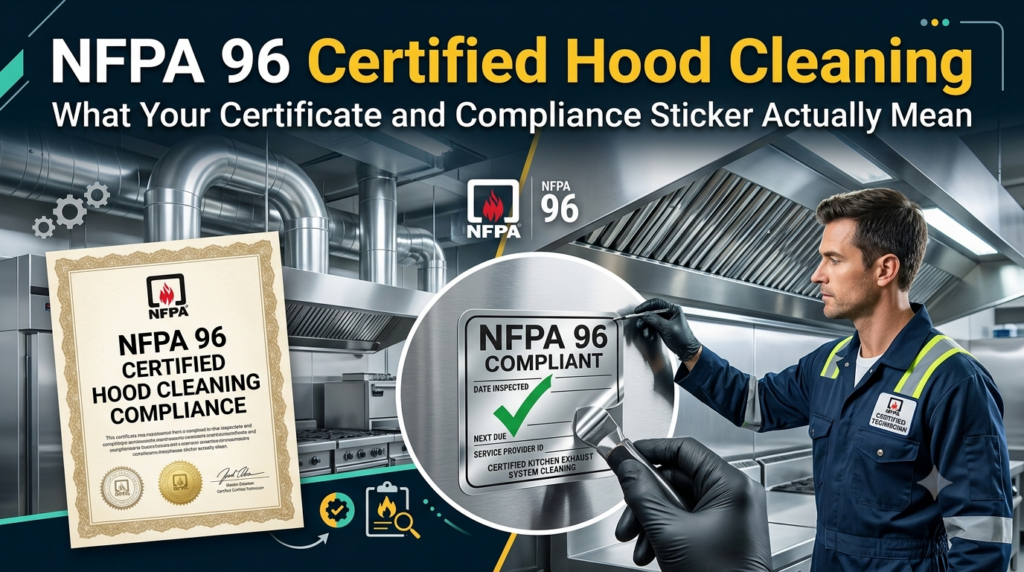
After a completed service, technicians place an NFPA 96 compliance sticker directly on the hood, usually noting the date of service and the company that performed the work. This sticker gives inspectors, fire marshals, and even your own staff a quick, visible reference point to confirm the system has been serviced recently. Without a visible sticker, an inspector has no immediate way to verify your kitchen is current on maintenance, which can trigger a deeper review or even a citation.
Why the Hood Cleaning Certificate Matters
Beyond the sticker, you should receive a formal hood cleaning certificate for every service. This document typically includes the date of service, the scope of work completed, and confirmation that the job was performed to NFPA 96 standards. Insurance providers frequently request this certificate when reviewing or renewing a policy, and in the event of a kitchen fire, it becomes a critical piece of evidence showing your business took fire safety seriously and followed required maintenance schedules.
The Role of Job Service Reports and Photos
A complete service package should also include a detailed job service report along with before-and-after photos of the hood, filters, ductwork, and rooftop fan. This level of documentation proves the work was thorough and not just a surface-level wipe-down. At Hood Cleaning Masters, this is standard on every visit — we believe commercial hood cleaning Ontario businesses rely on should always come with transparent, verifiable proof of work.
Why a Health and Safety Certificate Is Essential
Many restaurant owners are surprised to learn that a proper health and safety certificate is often required not just by fire marshals, but by landlords, franchise head offices, and insurance underwriters as part of ongoing compliance checks. Keeping these certificates organized and up to date across every cleaning cycle makes future inspections faster and removes the guesswork about whether your kitchen is currently compliant.
What Happens Without Proper Documentation
Restaurant owners sometimes assume that simply having their exhaust system cleaned is enough, without realizing that missing or incomplete paperwork can be treated almost the same as no cleaning at all during an inspection. Fire marshals and insurance adjusters need to verify claims, not just trust them. Without a valid certificate, compliance sticker, and job service report on file, a kitchen can be flagged as non-compliant even after a technician has physically completed the work, simply because there is nothing to prove it happened to standard.
Get Fully Documented Hood Cleaning From Hood Cleaning Masters
Certification and documentation are not just paperwork — they are proof that your kitchen is genuinely safe and compliant. Hood Cleaning Masters is proud to provide NFPA 96 certified hood cleaning across Ontario, complete with compliance stickers, cleaning certificates, and full inspection-ready reports after every visit. Contact Hood Cleaning Masters today to schedule your next service and keep your documentation audit-ready year-round.
Post Tags:
About Us
Hood Cleaning Masters provides NFPA 96-compliant commercial hood cleaning services across Ontario, helping restaurants maintain safer, cleaner, and inspection-ready kitchen exhaust systems.